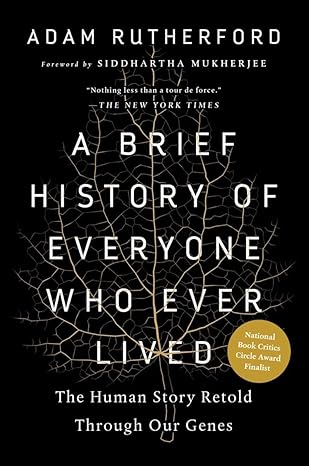
I am somewhat conflicted with this book, on the one hand enjoying its view of humanity through heredity and genetics, but on the other disliking the partiality of the author creeping up unnecessarily. First, the positive. Although not brimming with details, the author does a great job elaborating on his main thesis: how closely intertwined we all are to each other at the genetic level. Indeed, readers will likely be stunned at the modest number of generations it takes to find common ancestors with everyone around us, including total strangers. Likewise, and stemming from the premise that all non-African human populations originate from a small number of ancestral explorers who dared set foot outside Africa, Rutherford does a wonderful job dispelling many common misconceptions about race. But what should have been an objective and illustrative exposition of knowledge is marred by the author’s personal opinions and feelings entering the narrative. Mind you, I acknowledge that discussing human genetics is analogous to walking through a minefield; one wrong step and disaster ensues, but a reasonable author should nevertheless be able to examine sensitive material with kindness and dignity without being judgmental.
Some statements are trivial, such as “…Darwin beetled away, meticulously drawing up the best idea anyone ever had…” (pg 18, underlining mine), but still irritating as they are not factual. In this particular case, equivalent examples of epoch-changing ideas abound throughout history, not to mention that Darwin was not the only one mulling over these thoughts (think Alfred Wallace). Other tangents are odd, almost personal, as when the author takes several pages to defend red-heads, something that could have been done with a few well-crafted sentences to explain that the genetic polymorphisms responsible are unlikely to be maladaptive. And yet in other cases, the author’s biases are concerning. For instance, in his chapter on the genetics of the American continent, he suggests that mestizos (people of mixed ancestry) generated as a result of rape by European colonizers, but does not allow for the possibility of consensuality. After all, there is no reason to imagine that different human cultures cannot find common ground even in the face of a violent start. In fact, the author makes a big deal of how humans have generally been quite open minded when it comes to sex (so much so that Homo sapiens even reproduced with Neanderthals and Denisovans in the deep past), as discussed in his first chapter, aptly named “Horny and mobile”, so I find this disconnect unfair. An equally offensive stance is when the author uses his family tree to explain that he plausibly has Native American ancestry, but then bends over backwards to tell his readers that this in no way makes him culturally or politically a member of a Native American tribe, almost as he is embarrassed by the possibility. Granted, he does not want to ascribe membership to a group he clearly does not belong to, but he is so forceful in his defense that it makes him appear as an apologist. Given that the central theme of the book is how we are all more similar to each other than meets the eye, a more sensible approach would have been to celebrate this possibility as clear evidence for these similarities between distant peoples, even if in reality it won’t change one’s cultural identity.
And so it goes throughout the length of the book, from his obsession with Darwin to his apparent fear of being branded a racist, Rutherford’s personal views get in the way of the story. In many cases this is simply distracting, but in others it can lead to a misleading narrative. It is with this in mind that I leave the reader to decide whether or not to read this book. There is value to be had here, but naïve readers would benefit from other accounts of human genetics and history to get a more balanced view of this field. Yuval Noah Harari and Jared Diamond immediately come to mind.